



All the updates:
What is new in Google Cloud Data & AI? [Update November 2025]
The world of tech is changing fast, and data and artificial intelligence are at the centre of it all. To help you stay up to date, we at Devoteam have compiled the quarterly updates on data and AI solutions from Google Cloud.
Note: Features in Preview are early versions. Google releases them to get feedback, so they might not be available to everyone just yet. Anything with GA is now generally available.
Jump into the updates about:
1. Database Services
2. Data Analytics & Business Intelligence
3. Data Streaming & Engineering
4. Migration & Management
5. AI & Machine Learning
What is New in Database Services?
1. Cloud SQL Innovations
- Axion-based C4A machine series: Cloud SQL’s Enterprise Plus edition now supports the Axion-based C4A machine series in General Availability (GA). This offers nearly 50% better price-performance compared to N2 machines and up to 2x greater transactional throughput than comparable offerings.
- Memory Agent for PostgreSQL: Now generally available, the Memory Agent proactively detects and cancels high-memory connections to prevent restarts caused by OOM killers, including a recommender for alleviating memory pressure.
- Advanced Security & Recovery: Google introduced Customer-managed Active Directory integration for SQL Server (enabling Windows authentication without Google Managed AD), point-in-time recovery (PITR) for deleted instances, and enhanced Backups with immutable vaults.
- Operational Improvements: New features include a Precheck API for PostgreSQL to prevent upgrade failures, Managed Connection Pools (MySQL/Postgres) with IAM support, Read Pools for auto-balanced scaling, and AI-assisted troubleshooting in Enterprise Plus.
- Trial Cloud SQL at no-cost for 30 days: As of 19 November 2025, Google now offers free trial instances of Cloud SQL for MySQL and PostgreSQL, with no upfront commitment. Experience the power of this high performing, fully managed database today.
2. AlloyDB Advancements
- PostgreSQL 17 & Infrastructure: AlloyDB now supports PostgreSQL 17 (GA) and the C4A Axion processor, delivering faster query performance, incremental backups, and reduced entry prices for development environments.
- Compatibility & Extensions: Support for the tds_fdw extension enables direct access to SQL Server and Sybase. Additionally, Parameterised Secured Views (Preview) allow for granular row access control.
- Hybrid & Omni: AlloyDB Omni got a significant update with Kubernetes Operator 1.5.0 support, enabling OpenShift operations, high availability and disaster recovery.
- Query Optimizer Integration: Optimizer automatically chooses the most efficient execution based on selectivity statistics at query-planning time
- Adaptive Filtering (Preview): This allows to dynamically change execution based on runtime statistics.
- Columnar Engine (Preview): You can use columnar execution for filter evaluations and vector distance computations.
3. Spanner, Firestore & NoSQL
- Spanner Evolution: Google Cloud announced the next generation of Spanner-better-with-BigQuery capabilities for faster federated queries and streaming insights. The Spanner Columnar Engine (Preview) now enables analytical queries on live operational data.

- Firestore Updates: Firestore now supports MongoDB compatibility (GA), allowing developers to use familiar tools and drivers. New features also include Saved Queries in Firestore Studio and Database Cloning capabilities.
- Memorystore Scaling: Vertical Scaling is now available for Memorystore for Valkey and Redis Cluster, allowing effortless scaling up or down.
What is New in Data Analytics & Business Intelligence?
1. BigQuery Enhancements
- The Data Engineering Agent: Currently available in preview and powered by Gemini, this agent automates the most complex and time-consuming data engineering tasks in BigQuery Pipelines. This agent helps with pipeline creation and modification, automates code documentation as well as incorporates unique business logic and engineering best practices into custom agent instructions.
- Unified Ingestion: The completely redesigned «Add Data» experience simplifies ingestion by unifying Data Transfer Service, Datastream, and Dataflow into one intuitive interface.
- BigQuery-managed AI functions: Accessible in public preview, you can use the following functions – AI.IF, AI.CLASSIFY, and AI.SCORE – to leverage generative AI for common analytical tasks directly within your SQL queries. This eliminates the requirement for prompt tuning or integrating additional tools.
- The addition of TimesFM: A robust time-series foundation model developed by Google Research, is now available in BigQuery and AlloyDB. TimesFM simplifies the process of creating and deploying forecasting models by performing “zero-shot” forecasting.
- Transactional & Spark: New capabilities include Serverless Spark directly within BigQuery Studio and improved transactional operations like efficient fine-grained DML mutations.
- Disaster Recovery & Management: BigQuery now offers «Soft Failover» for planned drills without data loss and enhanced Workload Management for reservation fairness and autoscaler predictability.

2. Looker
- Developer Efficiency: Looker introduced Continuous Integration to streamline workflows and a Code Interpreter that uses Python for advanced analysis.
- Security: Looker Core on Google Cloud is now FedRAMP High authorised.
What is New in Data Streaming & Engineering?
1. Streaming Ecosystem
- Managed Kafka Connect: Now generally available, allowing replication of on-prem clusters to the cloud and seamless integration with BigQuery and Cloud Storage.
- Pub/Sub Transformations: Introduced Single Message Transforms (SMTs), starting with JavaScript UDFs, to validate or enrich messages in real-time within Pub/Sub.
- Workflow Orchestration: Apache Airflow 3 is now available on Cloud Composer 3, featuring DAG versioning and a modern UI.
- Iceberg REST Catalog: Now supported in BigLake metastore, users can query using their engine of choice across open-source engines such as Apache Spark and Trino.
2. Ingestion & Connectors
- Datastream Updates: Added support for MongoDB as a source and replication to BigLake Iceberg tables, enabling open lakehouse architectures.
- Bigtable Integration: The Bigtable Spark connector is now GA, opening support for Apache Iceberg workloads.
What is New in Migration & Management?
1. Migration Tools
- Database Migration Service (DMS): Now offers Object Level Observability for granular insight into table migrations. DMS also launched generally available support for Private Service Connect (PSC) and seamless SQL Server to AlloyDB migrations.
2. Fleet Management
- Database Center: Expanded support now includes monitoring for Oracle Exadata and Autonomous databases alongside Google Cloud services. Additionally, Database Center now extends fleet management to self-managed databases on Google Compute Engine.
What is New in AI & Machine Learning?
1. Agentic Development & Tools
- Agenspace becomes Gemini Enterprise: The Agentic AI platform got a major enhancement! Read all about the change and what it means for your business.
- The introduction of Gemini 3 Pro: Made generally available on 18 November 2025, this is Google’s latest Gemini model. Featuring state-of-the-art reasoning and world-leading multimodal understanding across text, image, video, audio and PDF, Gemini 3 Pro is explicitly designed with enhanced agentic capabilities.
- Gemini 3 Pro in GitHub Pilot: Google’s latest frontier model is now available in public preview for GitHub Copilot Pro, Pro+ Business, and Enterprise subscriptions.
- MCP Toolbox for Databases: Google released the Model Context Protocol (MCP) Toolbox, making it easier to connect AI assistants in your IDE to Google Cloud databases (AlloyDB, Cloud SQL, Spanner) for secure agentic development.
- Gemini CLI Extensions: Developers can now use open-source Gemini CLI extensions to interact with Cloud SQL, AlloyDB, and BigQuery directly from their local environment.
- Gemini 2.5 Computer Use Model: Google released the Gemini 2.5 Computer Use model via the Gemini API. This specialised model allows AI agents to interact directly with user interfaces, handling complex tasks like navigating websites and filling out forms.
- Vibe Coding in AI Studio: The new «vibe coding» experience lowers the barrier to building multimodal apps. Developers can simply describe an app idea, and Gemini automatically wires up the necessary models and APIs.
2. AI-Powered Analytics
- Vector Search & Natural Language: AlloyDB AI now supports Natural Language APIs in Public Preview. BigQuery introduced partitioned indexes for vector search, significantly reducing query costs.
- Conversational Analytics: The Conversational Analytics API (Preview) integrates NL2Query and code interpretation to turn natural language questions into data insights.
3. Creative Tools
- Flow & Veo 3.1: Google rolled out updates to the AI filmmaking tool Flow. With Veo 3.1, creators gain precision control, including using multiple images to style characters, bridging distinct frames into seamless video, and generating rich, integrated audio.
- Nano Banana: In August 2025, Google introduced the latest image editing model, Nano Banana from Gemini 2.5 Flash. Now Nano Banana capabilities are available in Google Search and NotebookLM (Preview) to enhance how users create and learn with visuals. This integration allows users to transform images instantly in Google Lens and unlocks new visual styles and summary formats within NotebookLM’s Video Overviews.
Ready to use the full potential of Google Cloud for Data & AI?
Talk to Devoteam’s experts today. We’ll help you figure out what you need and create a plan just for you. Our mission? To help you smoothly transition to a data-driven and AI-powered organisation.
What is new in Google Cloud Data & AI? [Update June 2025]
Just a note: Features in ‘Preview’ are early versions, so they might not be available to everyone just yet.
What’s new in Data & Analytics?
Google Cloud has announced several important updates to improve how you process and manage data. Many of these improvements are for BigQuery, Google’s main tool for data analytics.
1. BigQuery Platform Updates
The latest BigQuery updates focus on improving efficiency, flexibility, and integration:
- Event-driven Cloud Storage to BigQuery Transfer: It is now possible to set up data transfers to BigQuery that are automatically triggered by Cloud Storage write and update events, replacing previous scheduled or «hacky» methods.
- Run Python Defined in BigQuery DataFrames from dbt: For users leveraging dbt for data warehousing, Python code defined in BigQuery data frames can now be executed directly from dbt using its extension for BigQuery.
- Dataplex Automatic Discovery: This feature helps mature and larger organisations with data governance by automatically discovering and gathering metadata from Cloud Storage into the governance layer.
- Translation with DML/YAML Rules: Assisting with data migration from different databases to BigQuery, this feature now supports YAML rules to guide SQL dialect translation, offering more control, especially for common conversion issues.
- Group by STRUCT, ARRAY, and ALL Statements: BigQuery now supports grouping by all data types, including STRUCT and ARRAY, which are unique to BigQuery’s data modelling capabilities, greatly enhancing analytical flexibility.
- BigQuery Data Transfer Service Snowflake to BigQuery (Preview): A new capability allows direct replication of data from Snowflake to BigQuery via the BigQuery Data Transfer Service, simplifying migrations.
- Load and Export Data Between Regions: This crucial update enables seamless loading and exporting of data across different geographical regions, addressing previous complexities for international organisations or those with scattered billing exports.
- Continuous Queries with Autoscaling: For users of BigQuery Editions pricing, continuous queries now support autoscaling for slot reservations, optimising cost and performance by adjusting resource usage based on data ingress.
- Optional Job Creation Mode: This mode reduces overhead for small queries, leading to faster execution times for tasks like dashboard reporting or basic filtering on final data layers.
- Serverless PySpark in BigQuery Notebooks: BigQuery notebooks now support running serverless PySpark jobs, ideal for processing BigQuery data and tables, including external tables based on Cloud Storage.
2. BigQuery Developer Quality of Life Improvements
BigQuery also has some new features to make life easier for developers:
- Data Canvas Assistant (Preview): An AI-powered tool for creating data pipelines in a low-code, no-code interactive environment. It acts as a data science agent and can handle complex data processing tasks.
- Saved Query Changes Are Automatically Saved (Preview): This feature prevents loss of unsaved changes in saved queries, ensuring continuity during debugging or editing.
- Analytics Hub Renamed to BigQuery Sharing: Analytics Hub, used for sharing BigQuery data externally for monetisation or public benefit, has been rebranded to BigQuery Sharing, tying it more closely to the BigQuery ecosystem.
- Dark Mode in BigQuery and Dataform UI: A highly requested feature, dark mode is now supported across BigQuery and Dataform user interfaces, with an option to follow system settings.
- Manage IAM Tags from SQL: Users can now manage IAM tags directly from SQL, simplifying pipelines that previously required the Google Cloud CLI.
- Query Text Section in Execution Graph (Preview): This is a big help for fixing problems. The ‘execution graph’, which shows how a query runs, now includes the query text itself. This makes it much easier to find the source of a slow or complex query.
3. BigQuery Advanced Runtime (Preview)
This was a quiet but important announcement. This new runtime is designed to make your queries faster and cheaper by reading less data. The best part? There don’t seem to be any downsides. It will likely become the standard setting for everyone soon, giving you an automatic boost in speed and savings.
4. Other Google Cloud Database Updates
Beyond BigQuery, other Google Cloud database services also received important updates:
- Cloud SQL for SQL Server: Now offers AI-assisted troubleshooting to help identify and resolve performance issues.
- Spanner: It’s becoming a popular choice for new types of data, like graph and vector data, and now comes with a 90-day free trial. New features include running queries across different regions and using Spanner datasets in BigQuery.
- AlloyDB: This PostgreSQL-compatible database has a new, easier way to bring in vector data and prepare it for AI tasks. You can also now move to AlloyDB directly from your Cloud SQL for PostgreSQL backups.
5. Stream Analytics
Updates to streaming data services make them even better for real-time tasks:
- Dataproc Zero-Scale Clusters: Dataproc now supports scaling clusters down to zero, optimising costs for Apache Hadoop workloads when not in use.
- Share Pub/Sub Data Through BigQuery Sharing: You can now share your live data streams from Pub/Sub using BigQuery Sharing, which gives you professional tools for selling your data streams or sharing them with the public.
- Dataflow Right Fitting for Streaming: Previously available for batch processing, Dataflow’s right-fitting feature now extends to streaming, allowing precise resource allocation for pipeline components.
- Single Message Transformations (SMTs) in Pub/Sub: A highly anticipated feature, SMTs allow users to attach user-defined functions to Pub/Sub topics or subscriptions to perform lightweight, real-time transformations on messages, reducing the need for separate Cloud Functions or Cloud Run services.
What’s new in AI & ML?
The latest AI updates are changing how we use our digital tools. Google Search is getting an ‘AI Mode’ to handle tricky questions, a new model called Veo can create incredibly realistic videos, and Gemini is becoming a smarter assistant that you can talk to and that can complete tasks for you.
1. AI Mode – A Smarter Way to Search
Google Search is testing a new ‘AI Mode’ in Google Labs to improve searches for complex questions.
- Handles Complexity: Powered by a more advanced Gemini model, it can address nuanced, multi-part questions in a single search, such as comparing complex products or exploring new topics.
- Advanced Reasoning: It works by planning and running multiple searches simultaneously, synthesising information from various sources.
- Deeply Integrated: It is woven into Google’s core information systems, including the Knowledge Graph and shopping information, providing real-time, comprehensive answers.
- Discover More: Beyond summaries, it helps users explore topics in-depth and discover more relevant web content.
- Rollout: Currently, this feature is a limited, opt-in experiment for Google One AI Premium subscribers to provide feedback for rapid improvement.

2. Veo Video Generation Model
Veo is Google’s newest video generation model, available in a limited preview on Vertex AI.
- High-Definition Quality: It can create high-quality HD videos that are over a minute long, keeping people and objects consistent from scene to scene.
- Advanced Creative Control: Veo understands cinematic language, allowing users to request specific shots like time-lapses or aerial views.
- Native Audio Generation: This game-changing feature allows Veo to perfectly synchronise dialogue, sound effects, and background music with the generated video, setting it apart from other video models.
- Multi-Modal Understanding: It can understand instructions from text, images, and even other videos, helping it match your creative ideas.

3. Flow AI Filmmaking Interface
Flow is a new AI filmmaking tool, introduced at Google I/O, designed to help storytellers bring their ideas to life.
- Custom-Designed for Google AI: It integrates Veo, Imagen (for text-to-image), and Gemini (for intuitive prompting) to generate and manage video content.
- Creative Control & Consistent Creation: Users can manage assets, referred to as «ingredients,» and use a scene builder for seamless transitions, ensuring consistency and continuity across different clips.
- Inspiration & Learning: Flow TV offers a growing showcase of AI-generated content with visible prompts, serving as a valuable resource for learning new techniques.
- Accessibility: Flow is currently available to Google AI Pro and Ultra subscribers in the US, with plans for wider availability.
4. Gemini Live Intelligent Assistant
The goal for Gemini Live is to be like a real-life assistant that can understand the world through your device’s camera and microphone.
- Natural Conversation & Multimodal Understanding: Users can engage in seamless verbal dialogue and show Gemini what’s on their camera or screen for contextual assistance, for example, describing a messy drawer or a product on a webpage.
- Real-time Insights & Deep Integration: It provides immediate feedback and suggestions and integrates with applications like Google Maps, Gmail, and Calendar for better recommendations.
- Developer API (Live API): A preview developer API allows building agentic applications requiring real-time, low-latency voice and video interactions.
5. Gemini Agent Mode
Agent Mode is a major new feature that turns the Gemini app from a simple chatbot into a smart system that can use tools and interact with the digital world.
- Multi-tasking & Web Interaction: Drawing from DeepMind’s Project Mariner, this feature enables Gemini to take actions and complete tasks, distinguishing it from a mere chatbot.
- «Teach and Repeat» Learning: The agent learns to plan for similar tasks in the future by being shown a task once.
- Deep Tool & Service Integration: Built for deep integration with various tools and services via the Gemini API and MCP, it connects to other services like a real assistant would.
- End-to-End Task Completion: It can manage entire processes, such as booking flights while considering multiple constraints like destination, dates, budget, and weather, by interacting with various websites and apps.
- Rollout: An experimental version of Agent Mode is expected to be available soon for Gemini app subscribers.
6. Agentspace Updates
There are several updates to Agentspace, the central place for your organisation’s agents.

- App-level Feature Management: Users can now toggle the visibility of the agent gallery, prompt gallery, no-code agent creation, and NotebookLM enterprise within the GCP project settings.
- Chat about Uploaded Content: The ability to chat about uploaded Excel files has been enhanced to support files with multiple sheets, which was not previously possible.
- Choose Your Model: Users can now select between Gemini 2.5 Flash and 2.5 Pro models, or opt for automatic selection for optimal performance.
- Two Types of Agents:
- No-code agents: These allow saving prompts with context and connecting to specific data sources and tools, empowering agents for specialised domains.
- Custom agents: Developed using the Agent Development Kit (ADK), an open-source framework designed for orchestrating agentic workflows, these agents can be deployed on Vertex AI Engine and brought into Agent Space, offering virtually limitless customisation.
Conclusion
As you can see from all these updates, Google Cloud is constantly improving its Data and AI tools. These changes help companies build smarter apps that work in real time and keep up with the fast pace of technology. The focus on built-in AI, a better developer experience, and powerful agent tools highlights that Google is dedicated to providing a smart and easy-to-use platform that connects data to AI.
Please get in touch today if you’d like to learn more about these updates or chat with our experts at Devoteam about how they could help your business.
Ready to use the full potential of Google Cloud for Data & AI?
Talk to Devoteam’s experts today. We’ll help you figure out what you need and create a plan just for you. Our mission? To help you smoothly transition to a data-driven and AI-powered organisation.
What is new in Google Cloud Data & AI? [Update April 2025]
Digital transformation continues its pace, with data and artificial intelligence (AI) at its very heart. So, what are the exciting developments within Google Cloud’s Data & AI ecosystem? Our experts, Tristan Van Thielen, leading the AI front, and Mátyás Manninger, guide you through the Google Cloud data & AI landscape.
What’s new in AI?
The latest AI updates focus on infrastructure, powerful models, and tools that empower developers and businesses with agents.
1. Infrastructure Layer
The foundational layer supporting AI workloads has seen significant upgrades.
AI Hypercomputer
- Ironwood, Google Cloud’s 7th generation TPU, provides unparalleled performance for demanding AI workloads. This new Tensor Processing Unit is reported to be around 20 times more efficient than its predecessor, directly benefiting Google’s large language model (LLM) training and also enhancing inference capabilities.
- vLLM for TPUs makes it easier to host these models on Compute Engine, Google Kubernetes Engine (GKE), Vertex AI, and Dataflow. This offering simplifies the distribution of these models across both TPUs and GPUs, ultimately leading to faster inference on Google Cloud Platform.
- Pathways, Google’s internal ML runtime for large-scale training and inference workloads, is now available with Jax
Cloud Wan
Addressing crucial concerns around data privacy and security in the cloud, Cloud WAN provides a new cloud-wide area network. This allows for connecting multi-cloud environments (like Amazon Web Services and GCP) and private data centres through Google’s robust backbone network, all while maintaining layer 2 separated traffic. This enhances data privacy, bolsters security, and reduces the overhead of managing complex internet infrastructure.
Gemini on your infrastructure
For organisations with particularly stringent privacy requirements, Gemini on Google Distributed Cloud offers to run Google’s flagship AI model within private data centres or sovereign clouds. It provides even tighter data controls. Run Gemini on your own on-premises infrastructure. Gemini models can run on top of NVIDIA DGX and HGX platforms.
2. AI Model Innovations
- The arrival of Gemini 2.5 Flash and Pro on Vertex AI is an important development.
- Gemini 2.5 Pro is reportedly leading in benchmarks across various performance categories and is currently available in preview.
- Complementing this is Gemini 2.5 Flash, a faster iteration of the 2.5 model with a slight performance trade-off intended to supersede previous fast models and deliver even greater power.
- The Vertex AI Model Optimiser automatically selects the most suitable Gemini model (Flash or Pro) based on task complexity and desired performance, optimising cost without sacrificing user experience.
- The Live API enables real-time interactive experiences like video calls powered by Gemini.
- Google continues to push the boundaries of generative AI with its Generative AI Media Models. Did you know? Vertex AI is the only platform with generative media models across all modalities.
- Veo 2.0 for generating videos from text or existing frames,
- Lyria, their music generation model, and
- Chirp 3, the latest text-to-speech model, is expected to underpin various GCP services.
- Imagen 3: The text-to-image model can generate images with even better detail, richer lighting and fewer distracting artefacts than our previous models.
- Grounding in Google Maps. This new ability ensures that agent responses relying on location context are factual and fresh.
3. Agent Platform & Vertex AI
Google strongly emphasises AI agents, providing new tools and platforms for building and managing them.
Vertex AI introduces several new ways to build and scale sophisticated multi-agent systems through its Vertex AI Agent Builder. The Vertex AI Agent Engine enables the deployment of AI agents with enterprise-grade confidence. It supports agents built with any agentic framework and offers seamless scalability and compliance features. It enhances agent intelligence by providing memory for persistent sessions and tools for performance measurement and improvement while also driving enterprise adoption through built-in integration with Google Agentspace.
The Agent Development Kit (ADK) provides an open-source framework for building customisable agents. It incorporates agent-building best practices to streamline the development of multi-agent applications with Python and extensive documentation while maintaining full control and observability. To accelerate development, the Agent Garden offers a curated collection of pre-built agent samples, solutions, tools, and frameworks.
The Agent2Agent Open Protocol facilitates the connection of agents across an enterprise ecosystem. How? By providing a common language for collaboration, regardless of the underlying framework or model. It aims to eliminate agent silos through efficient communication and data exchange. Google collaborated with over 50 partners to develop this protocol. These components collectively empower developers to construct and deploy robust and scalable multi-agent systems within the Vertex AI platform.
Google Agentspace emerges as a central hub where all organisation agents become accessible. This includes Google-built agents, custom-built agents (using the ADK or no-code/low-code options within Agentspace), and third-party agents. Agentspace empowers end-users to automate tasks without needing to code. Agents can also be promoted to organisation-approved status. Additionally, an integration with Chrome Enterprise allows direct access from the Chrome search bar. New pre-made agents include a Deep Research agent and an Idea Generation agent.
4. Packaged Agents:
Google is offering a range of ready-to-use agents across its services. These include:
- Data Agents in BigQuery for data engineering and conversational analytics,
- Security Agents like the new Google SecOps agent to help triage security alerts.
- Code Assist Agents similar to GitHub Copilot, powered by Gemini 2.5 Pro for enhanced developer productivity.
- and various Purpose-Built Agents tailored for specific use cases like food ordering and customer experience enhancements.
5. AI-Powered Products
- Google Unified Security suites now boast numerous new AI features to improve threat visibility, detection, and response.
- The Customer Engagement Suite combines multimodal interactions with Gemini in video calls, real-time feedback using knowledge bases, and seamless escalation to human agents, aiming to revolutionise customer support. Read more in our article on how AI impacts customer service.
What’s New in Data & Analytics?
Data and analytics on Google Cloud also see AI-driven enhancements. The focus? Making data work harder and smarter.
? Did you know?
- Using BigQuery and Vertex AI together can save you a lot of money—they are 8 to 16 times cheaper than similar tools for managing data and using AI.
- BigQuery has five times more customers than the two main competitors, who only offer tools for data storage and analysis.
- AlloyDB AI’s special search feature (ScaNN index) is much speedier than the standard one in PostgreSQL (HNSW index). It can find things up to 4 times faster in general, and up to 10 times faster when you narrow your search.
1. BigQuery Platform
BigQuery is an autonomous data-to-AI platform providing customers with a flexible, integrated, and intelligent platform with automation and agentic capabilities for the entire data lifecycle and all data teams, including data engineers, scientists, and analysts.
- Google’s powerful data warehouse receives an AI infusion through Gemini in BigQuery. New features in preview include a Code Assistant to aid in writing SQL queries and Python notebooks within BigQuery Studio. Translation and Migration Assistance will help in converting SQL queries during database migrations. A new metadata curation engine analyses tables, metadata, and queries to automatically generate more metadata and improve understanding of the data landscape. Data Insight provides automated insights and suggests relevant queries.
- The new BigQuery Multimodal Tables (in preview) allow storing unstructured data alongside structured data, unlocking a wealth of new AI and machine learning use cases.
- The AI Query Engine (pre-announcement) promises a revolutionary way to write queries using natural language, even incorporating references to external knowledge.
- The BigQuery Metastore simplifies data discovery for external engines by exposing the understanding of the underlying metadata.
- For cost optimisation, BigQuery Workload Management automates resource scaling, and BigQuery Spend Commit offers predictable costs.
2. Looker
Looker is Google Cloud’s AI for BI solution. It delivers conversational analytics, allowing customers to interact with their data more easily and intuitively. Customers can also add Looker Reports via Studio in Looker.
Looker is well-positioned for AI integration. The new Conversational Analytics API (Preview) allows embedding Looker’s chat-based data exploration into custom applications. Gemini in Looker (Preview) enhances productivity by generating LookML code, simplifying the folding process, and assisting in creating visualisations and formulas. Looker Reports (GA) provides a new avenue for data storytelling and exploration, integrated with the new Studio Looker, which can directly connect to various data sources like Microsoft Excel.
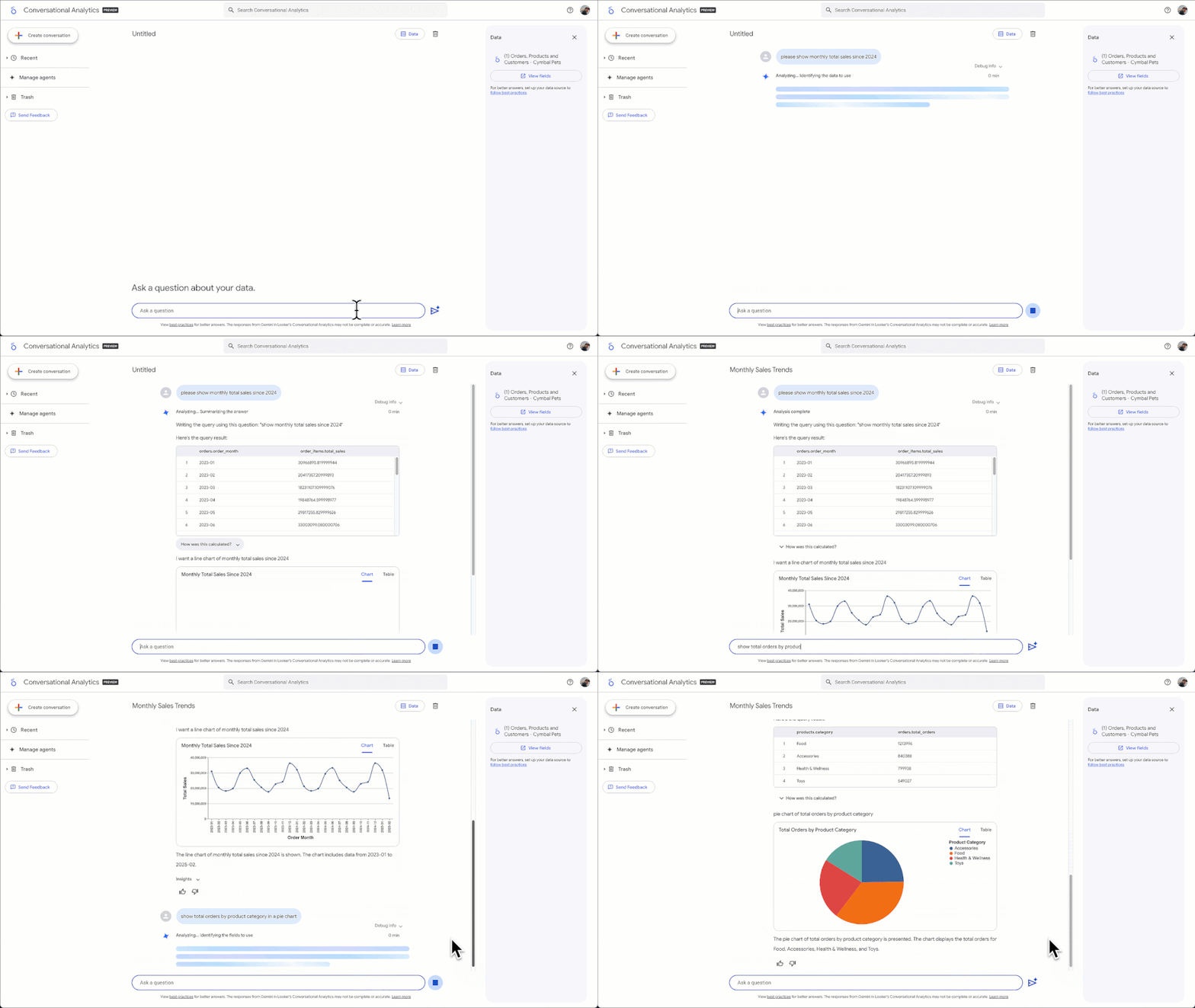
Gemini in Looker conversational analytics
3. Databases
Google Cloud enables you to create databases that help you build next-generation AI applications and agents. Enjoy freedom of choice as a developer, and migrate and modernise your database estate.
Google’s PostgreSQL-compatible database service, AlloyDB, has received significant AI-powered upgrades.
- Integration with Google Agentspace now allows searching AlloyDB data through Agentspace agents.
- Natural language support enables querying AlloyDB using everyday language.
- With optimised SQL and vector search, AlloyDB becomes a high-performance vector database for Retrieval-Augmented Generation (RAG) and agentic workflows.
- Three new Gen AI models on Vertex AI and the AI Query Engine allow leveraging generative AI directly within AlloyDB for tasks like generating embeddings using SQL.
Other Key database product announcements:
- Firestore with MongoDB compatibility simplifies migration for applications currently using MongoDB APIs.
- ARM support for Cloud SQL and AlloyDB is now available on new C4A instances, offering an improved price-performance ratio.
- Google is expanding the availability of Oracle and Google Cloud Services. In 2025, more regions will be available for deploying Oracle databases, starting with Exadata X1M.
- For SQL Server modernisation, Google offers various services and tools, including a migration service, to support seamless migration from SQL Server to PostgreSQL, with Gemini models assisting in query translation.
- Bigtable Releases: For users of Google’s NoSQL big data service, Bigtable, new features include a Kafka Sink for directly saving Kafka topic data into Bigtable, SQL Support for querying Bigtable data (even time-series data with arrays), and Views for creating SQL-based views, including continuous materialised and logical views.
- General Data & AI Updates: Users can expect more user-friendly SQL features like pipe syntax across the board, along with cost-related features for Firestore and BigQuery, demonstrating Google’s commitment to both functionality and value.
Conclusion
Google Cloud continues to innovate its Data and AI ecosystem. How? With infrastructure enhancements, powerful new AI models, and deeply integrated AI capabilities within data analytics tools. The advancements offer opportunities for tech experts and business leaders looking to facilitate digital transformation.
If you want to explore any of these announcements further or discuss how they might benefit your organisation, please do not hesitate to contact the experts at Devoteam.
Ready to use the full potential of Google Cloud for Data & AI?
Talk to Devoteam’s experts today. We’ll help you figure out what you need and create a plan just for you. Our mission? To help you smoothly transition to a data-driven and AI-powered organisation.
What is new in Google Cloud Data & AI? [Update September 2024]
What is new in Google Cloud Data & AI? [Update September 2024]
Google Cloud continues to innovate in data and AI, pushing the boundaries of analytics and artificial intelligence. Devoteam’s Google Cloud experts highlight what’s new since the previous months – focusing on advancing BigQuery’s capabilities, enhancing AI models, and optimising database solutions. Let’s explore the most significant updates.
AI Innovations with Gemini and Imagen
The Gemini 1.5 series has received notable upgrades, featuring 2 model variants:
- Gemini 1.5 Pro: A high-performance model offering multimodal capabilities and extended context windows (up to 2M tokens). Suitable for complex, large-scale tasks where high-quality outputs are essential.
- Gemini 1.5 Flash: A low-latency, cost-effective option that provides similar quality to the Pro version on most common tasks but is optimised for speed.
Further complementing the Gemini 1.5 series is Google’s latest image generation model, Imagen 3, which:
- Offers superior quality, aesthetics, and prompt adherence
- Has a faster generation speed of four images in less than 9 seconds
- Includes a digital watermarking feature for enhanced safety and compliance.
Efficiency Meets Savings: Context Caching and Grounding
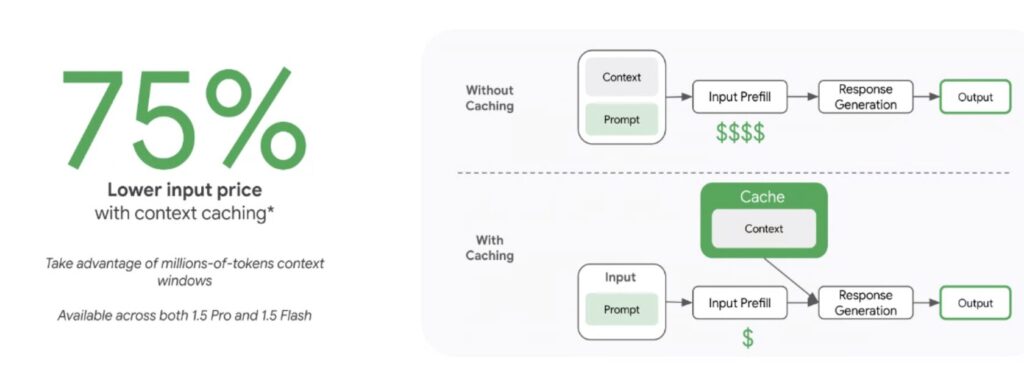
Google Cloud’s context caching is a game-changer, allowing customers to drastically reduce costs by up to 75% by efficiently managing large context windows. With the ability to reuse fixed contexts for subsequent queries, enterprises can optimise performance while minimising expenses.
Additionally, grounding mechanisms with Gemini models enable more factual responses by dynamically integrating relevant context, which is crucial for maintaining accuracy in AI-powered applications.

Imagine you have a large dataset of research papers and need to answer various questions about them. By processing the dataset once and caching the key information, you can store that knowledge and quickly retrieve answers from the same cache context, saving significant time and resources.

Tristan Van Thielen
ML Tribe Lead Google Cloud Business Unit at Devoteam
Gemma 2: Elevating Open AI Models for Enterprises
Gemma 2 is a cutting-edge series of open models built on the technology of the Gemini family. It comes in two larger sizes, 9B and 27B, and can be easily deployed using Vertex AI or Google Kubernetes Engine (GKE). Pre-built starter notebooks will soon be available. The Gemma Cookbook offers practical guides for customising and fine-tuning models, and Gemma 2 is now available on Hugging Face and Vertex AI Model Garden.
BigQuery and Data Analytics: Continuous Real-Time Analytics
BigQuery’s continuous real-time analytics feature introduces unbounded SQL processing for real-time anomaly detection and dynamic data enrichment. It enables developers to build event-driven applications that respond as soon as data arrives.
- Partition Enhancements: Maximum partition count increased from 4,000 to 10,000, enabling BigQuery to handle up to 27 years of day-partitioned data
- AlloyDB Federated Queries: Now supports querying AlloyDB tables directly from BigQuery, offering a unified analytics experience across data silos.
AlloyDB: Bringing AI to PostgreSQL
AlloyDB is tailored for operational and analytical workloads. It supports vector search and embeddings using the ScaNN algorithm, delivering up to 4x faster search performance than standard PostgreSQL.
- AlloyDB Omni: Supports on-premises and hybrid deployments across different environments, maintaining PostgreSQL compatibility.
- Free Trial Cluster: Now available, with up to 1TB of storage and an 8 vCPU instance, this cluster allows businesses to experiment before committing to larger-scale implementations.
Expanded Capabilities in Cloud Storage and Cloud SQL
Google Cloud Storage has introduced the following features:
- Hierarchical Namespaces: Provides true folder-based operations for seamless file management in Cloud Storage. Ideal for AI and machine learning workloads.
Google CloudSQL has introduced the following features:
- PostgreSQL 16 support
- Point-in-time recovery
- IAM group authentication, making database management and security more robust and flexible.
Spanner, Google’s globally distributed database, has also received significant upgrades such as:
- Spanner Graph: Adds native graph database capabilities for complex relationship modelling and analysis.
- Geo-Partitioning: Improves data locality, reducing latency for globally distributed datasets. Ideal for scenarios requiring compliance with data residency requirements.
Wrapping Up: Another Step Forward
With powerful AI models, advanced analytics, and high-performance databases, Google Cloud’s latest offerings enable businesses to build intelligent, real-time applications. The focus on context management, grounding, and scalable solutions reflects Google’s commitment to equipping enterprises for next-generation digital transformation.
Watch a recap of our online session to explore the full range of updates and learn how Google Cloud sets new data and AI innovation standards.
What is new in Google Cloud Data & AI? [Update July 2024]
What is new in Google Cloud Data & AI? [Update July 2024]
Mastering data essentials is key for businesses to thrive. Data analytics is at the heart of making informed business decisions. Google Cloud Data Essentials is a suite of services designed to help businesses manage their data more effectively. It includes various tools for data storage, analytics, security, and migration. These tools help businesses gain deeper insights into their data, enabling them to make better decisions and drive growth.
In 2024, customers struggle with many individual data services stitched together to support end-to-end data analytics. BigQuery differentiates with a radically simple and unified data platform. Even better, it works across all types of data and workloads to meet the needs of the new AI era. BigQuery goes beyond just SQL.
It supports various engines, including Spark and Python. With the power of Gemini integrated into BigQuery, users can leverage leading LLMs on their enterprise data and take advantage of GenAI-powered assistance throughout the platform.
See how Google Cloud ensures BigQuery goes beyond data essentials, providing a comprehensive solution for modern data challenges.
Strengthened Data Analytics Features in BigQuery
Google Cloud continues to enhance BigQuery’s functionalities with lots of improvements. Here are 8 improvements that Devoteam’s data experts see as highlights:
- Advanced Metadata Cataloging: BigQuery enhances data discoverability and governance with Dataplex’s metadata graph. It automatically ingests and indexes metadata across analytics, lakes, databases, AI, and BI services. You can use it to empower self-service data access and lay a robust foundation for data governance. Cataloguing now includes Bigtable, Spanner, and Cloud SQL metadata, with upcoming support for Looker and Vertex AI models and datasets.
- BigQuery Workflows in BigQuery Studio allow users to schedule data processing tasks, like SQL scripts and Python notebooks, in your workflows. You can even build your workflows visually, without writing code.
- Continuous Real-Time Analytics: BigQuery introduces continuous queries, allowing unbounded analytical processing via SQL. This new feature processes data the moment it arrives, enabling real-time anomaly detection, prediction, and sentiment analysis. Integrated with Vertex AI, Bigtable, and Pub/Sub, it supports developing responsive, event-driven applications and reverse ETL capabilities.
- Serverless Composer for Data to AI Workflow Orchestration: The new serverless Composer simplifies complex pipeline orchestration, focusing on creation and execution rather than infrastructure management. It features a library of 400+ open-source connectors, enterprise-grade security, and a one-click network setup.
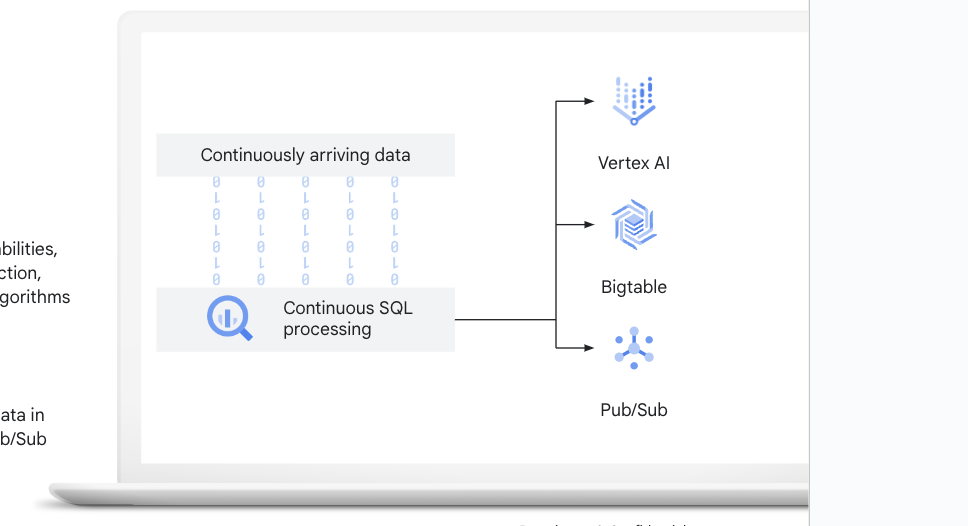
- Seamless Data Ingestion with Apache Kafka Integration: BigQuery now integrates seamlessly with Apache Kafka. It is the Apache Kafka you know, but then managed.
- Query acceleration improvements bring improved query performance with no changes to workloads. BigQuery intelligently analyses historical usage patterns to optimise performance automatically.. BigQuery takes care of the technical under-the-hood adjustments, allowing you to focus on extracting insights from your data. BigQuery ML integrations enable leveraging Google’s LLMs for speech-to-text, vision, translation, and Doc AI models, with unstructured data stored in GCS or BigQuery Storage. As a part of the data to AI journey, you will increasingly need to leverage all of your organisational assets, including unstructured data to make this happen. For example, you could use BigQuery ML to predict the likelihood of a rental house being rented not only based on the location and the number of bedrooms, but the photos of the house.
- Vector Embeddings and Search for LLMs: BigQuery now supports vector embeddings and search, enhancing LLM capabilities with use cases like retrieval augmented generation (RAG). This feature enables semantic and similarity search, improving recommendation engines and LLM accuracy. It for example enables experiences like product recommendation engines, which might search for similar products to the ones a user has previously interacted with.
Reimagine Your Data Essentials & AI Journey with Gemini in BigQuery
It’s clear, BigQuery is a powerful tool that takes data essentials to another level, offering powerful tools for advanced analytics. But what if you could unlock even more potential? By adding Gemini in BigQuery of course! It reimagines the entire data and AI experience. Now, you can get constant support throughout your data journey. For instance, use the chat interface for user-initiated assistance, or leverage background agents that learn your business and automate tasks proactively. Imagine agents that optimise performance and take action for you!
Data Essentials: Gemini in BigQuery empowers you to:
- Simplify complex tasks with AI-powered assistance.
- Gain insights faster with visual data discovery and semantic search.
- Optimise workloads and accelerate migrations.
Discover Gemini in BigQuery features in-depth:
- AI-Assisted Visual Data Prep: BigQuery data preparation will provide natural language-first visual data transformation capabilities that allow the creation of BigQuery datasets from multiple sources.
- Visual & AI-Driven Discovery: Explore, discover, and analyse data with BigQuery Data Canvas. This GenAI-powered experience offers an iterative, guided journey within BigQuery Studio. Discover data assets using natural language searches.
- GenAI Powered Semantic Search: Don’t just have access to data, make access to insights easier! We understand the struggle of staring at a data mountain unsure where to begin. Gemini leverages GenAI on Dataplex metadata to create a customised list of questions you can ask of your data. Simply click a question to see a response – Gemini in BigQuery auto-generates and runs SQL statements, giving you meaningful answers with a single click. This solves the cold-start problem and jumpstarts your analysis.
- Spend Less Time on Infrastructure: Leverage AI to receive recommendations on partitioning, clustering, and materialised views to optimise compute costs and performance. Additionally, serverless Spark autotunes for performance and resilience, with GenAI assisting in troubleshooting Spark failures
- Accelerate EDW Migrations: LLM-Enhanced Translations: Enhance the coverage and accuracy of industry-leading compiler translations with Large Language Models (LLMs).
It’s time to reimagine your data essentials and AI experience. Let Gemini in BigQuery be your guide.
Looker: Conversational Analytics and Enhanced Data Visualisation
Looker, Google Cloud’s data analytics platform, is also evolving:
- Conversational Analytics: Deeper Understanding Through Dialogue: Looker’s conversational analytics allows users to have interactive dialogues with their data using natural language. Imagine asking questions like “What are the top factors influencing customer churn?” in plain English and receiving clear and concise answers with visualisations. This empowers users to explore data independently and gain a deeper understanding.
 Sven HermansHead of Data u0026 Analytics at Devoteam G Cloud
- Looker Studio Pro Integration: Unified Workspace Management: Looker Studio Pro integrates seamlessly with Looker, providing a combined feature set and unified workspace management. This eliminates the need to switch between different tools and streamlines the data visualisation and communication process.
Ready to use the full potential of Google Cloud for Data & AI?
Talk to Devoteam’s experts today. We’ll help you figure out what you need and create a plan just for you. Our mission? To help you smoothly transition to a data-driven and AI-powered organisation.